

Table of Contents
- Cargo Net vs Storage Box: Quick Comparison
- How to Secure Cargo in a Truck Bed
- Truck Bed Storage Ideas and Cargo Organization
- Using Truck Bed Tie-Down Points and Anchor Systems
- Cargo Security, Weather Protection, and Load Limits
- Fitment, Compatibility, and Cost Considerations
- Which Option Should You Choose?
- Frequently Asked Questions
Last Updated: October 5, 2026
Cargo Net vs Storage Box: Quick Comparison
A cargo net vs storage box decision comes down to what you're hauling, how often you need access, and whether weather protection matters.

Cargo nets keep loose items from sliding around. They're lightweight, affordable, and install in seconds using your truck's existing bed hooks. Storage boxes offer weather protection and security for tools and valuables, but take up more space and cost more upfront.
| Feature | Cargo Net | Storage Box |
|---|---|---|
| Weather Protection | None | Full coverage |
| Security | Open to theft | Locked/secure |
| Cost | Lower | Higher |
| Installation | Seconds | Minutes to hours |
| Flexibility | Adapts to any load | Fixed compartment |
| Best For | Loose cargo, groceries | Tools, valuables, daily gear |
How to Secure Cargo in a Truck Bed
Securing cargo properly prevents accidents and protects your load. The right method depends on what you're hauling.
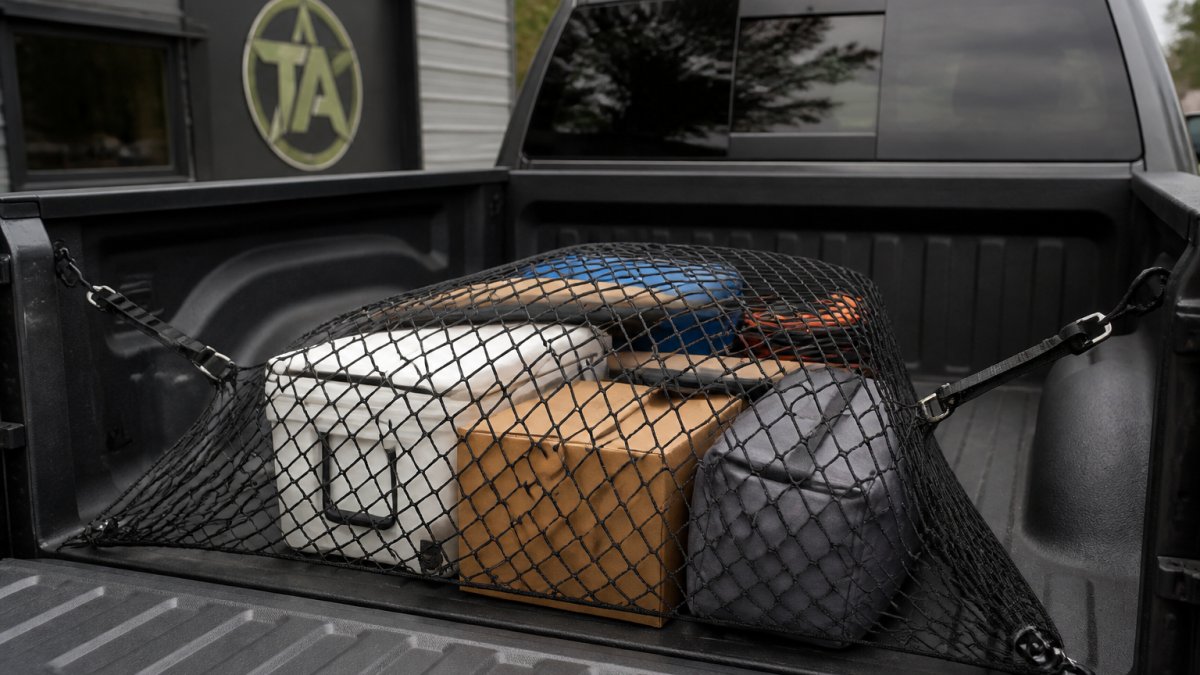
Cargo Nets for Loose Items
A cargo net distributes pressure across multiple tie-down points, creating a barrier that prevents items from shifting during acceleration, braking, or cornering.
Cargo nets are ideal for groceries, landscaping materials, camping gear, and light loads, especially mixed shapes and sizes since the net conforms to whatever you're carrying. Installation takes seconds: hook the corners into your bed's anchor points and pull it tight.
Storage Boxes for Protected Storage
Storage boxes are rigid containers that bolt or clamp to your truck bed, offering weather protection and security. Many feature locking mechanisms that deter opportunistic theft.
A storage box is right if you carry tools regularly, need weather protection, or want to secure expensive equipment. The downside is cost and permanence, once installed, you're committed to that location and style.

Truck Bed Storage Ideas and Cargo Organization
Most truck owners benefit from combining both: a cargo net for everyday loose items and a storage box for tools or valuables.
Consider your truck's layout. Smaller beds require strategy, a wheel-well toolbox preserves most of the bed while keeping tools accessible.

Think about access patterns. If you need tools daily, a wheel-well or side-rail box keeps them within arm's reach.
Using Truck Bed Tie-Down Points and Anchor Systems
Your truck bed has built-in anchor points, typically D-rings or hooks along the sides and corners, designed for securing cargo.
Cargo nets rely entirely on these anchor points.
Storage boxes also use anchor points, bolting to the bed rail or clamping to the side walls.
Many owners overlook bed outlets and power ports. Some newer trucks include 12V outlets in the bed.
Cargo Security, Weather Protection, and Load Limits
This is where the two options diverge most, and where most buying mistakes happen. A net and a box solve different problems, and neither substitutes for the other on security, weather, or load rating.
Security: deterrence vs. containment
A cargo net contains cargo, it does not protect it. Anything under the net is visible, and a net offers no meaningful resistance to someone reaching in.
A storage box adds a physical barrier and a lock, though protection varies widely by product:
- Light-duty latch and key lock: stops opportunistic theft in a parking lot, but a determined thief with hand tools can defeat it.
- Reinforced latch with a padlock hasp: meaningfully harder to pry, and the padlock can be upgraded independently of the box.
- Integrated cam lock or cylinder lock: convenient, but the lock cylinder is often the weak point on budget boxes.
No bed-mounted box is a safe. If you carry high-value tools daily, treat the box as one layer: lock it, park in lit areas, and consider a lockable tonneau or hard cover over the top for a second barrier.
Weather protection: sealed vs. exposed
A cargo net leaves everything exposed to rain, snow, road spray, dust, and UV. That's the design, not a defect, if your cargo is weather-tolerant, exposure doesn't matter.
Storage boxes are sold as weather-resistant, but "weather-resistant" and "waterproof" aren't the same claim. The variables that matter:
Truck Bed Side Rail Tool Box - 80TBS20072 →
- Lid seal: a continuous bulb or blade seal around the lid perimeter keeps most rain and dust out. A box with no seal, or a seal that's compressed flat, will let water in during a hard rain or a car wash.
- Drainage: some boxes have channels or weep holes that route water away from the lid seam. Boxes without drainage can pool water on the lid and drip into the bed when you open them.
- Material: aluminum and stainless steel resist rust; powder-coated steel can chip and rust at the chip; plastic and polyethylene won't rust but can become brittle with long UV exposure.
If you're storing electronics, paper, or anything that rusts, assume you need a sealed box with a gasketed lid, and check the seal after a few months, since seals compress and dry out over time.
Load limits: read the rating, don't guess
This is the part most buyers skip, and it's the part that causes failures.
Cargo nets are rated for a working load that assumes proper tension across the correct number of anchor points.
Storage boxes are rated by two numbers that are often confused:
- Box capacity: how much weight the box itself can hold without deforming or cracking at the mounting points.
- Mounting capacity: how much weight the mounting hardware and the truck's bed rail or bed floor can support.
The lower of the two is your real limit. A box rated for 400 lb bolted to a bed rail not reinforced for that load is still a 400 lb problem waiting to happen.
Safe tie-down practices that apply to both
- Match the anchor to the load. Factory hooks and D-rings are for general cargo, not a motorcycle or a pallet of concrete. Use aftermarket tie-downs with published working-load ratings for heavy or high-value loads.
- Use more than two points. Two-point tie-downs let cargo pivot; four points (or a net with four or more corners) control movement in every direction.
- Check tension after the first few miles. Cargo settles, straps stretch, and nets relax. A quick re-tension stop is cheap insurance.
Fitment, Compatibility, and Cost Considerations
Fitment is where most returns happen, and the easiest part to get right before you buy. Run through this checklist for either option.
Fitment checklist for a cargo net
- Bed length and width: Nets are sized for short (roughly 5.5 ft), standard (roughly 6.5 ft), and long (roughly 8 ft) beds, and widths vary between compact, mid-size, and full-size trucks. A net sized for a full-size 6.5-foot bed will be slack on a mid-size 5-foot bed and won't tension properly.
- Anchor point count and location: Count your factory tie-downs. A net expecting six attachment corners won't work well on a truck with only four hooks, and vice versa.
- Tonneau cover clearance: Check whether the net's hooks or straps interfere with the cover's rails or folding/rolling mechanism. Low-profile covers leave very little room.
Fitment checklist for a storage box
- Bed dimensions, not just bed length: Cross-bed boxes are sized to the bed's interior width at the front, which varies by truck. A box fitting a full-size bed may not fit a mid-size bed even if both are "6.5-foot" beds.
- Bed rail height and shape: Rail-mounted boxes clamp to the top of the bed rail. Rail height, thickness, and whether it has a plastic cap or track system all affect whether a given clamp works.
- Bed rail systems: Trucks with factory bed rail tracks (common on newer trucks) may need box-specific mounting brackets rather than universal clamps.
Cost of ownership, not just purchase price
Sticker price is only part of the story. Here's how the two options typically compare over the life of the truck:
| Cost factor | Cargo net | Storage box |
|---|---|---|
| Upfront cost | Lower | Higher |
| Installation | None, hooks on in seconds | Bolting or clamping; may need tools and a second person |
| Maintenance | Re-tension; replace when UV-degraded | Check lid seal, latch, lock, and mounting hardware periodically |
| Replacement cycle | Shorter, webbing and bungee degrade with sun exposure | Longer, a well-built box can outlast the truck |
| Resale / transfer | Easy to move to a new truck | May or may not fit your next truck; check before assuming |
| Hidden costs | None typical | Potential bed drilling, touch-up paint, or bracket kits |
A net is the lower-commitment option: cheap, easy to replace, easy to move to another truck. A box is higher-commitment: more upfront, more installation effort, and a fitment risk if you change trucks. For daily tool carriers, the box's durability and security justify the higher entry cost. For groceries, gear, or landscaping material, a net plus a few good straps is often the better value.
The combination approach
Many owners run both, and fitment math makes it work. A side-rail or wheel-well box preserves most of the bed floor for a net; a full-width cross-bed box does not. If you want both, decide the box location first, then size the net to the remaining space.
Truck Army carries several storage solutions built for different bed configurations. The Truck Bed Side Rail Tool Box keeps tools accessible along the rail while leaving the bed floor open. The Wheel Well Tool Box Passenger Side uses the space above the wheel well so the rest of the bed stays usable. For a traditional front-of-bed setup, the Single Lid Tool Box For Full Size Trucks offers lockable, weather-resistant storage, just confirm it fits your specific bed length and rail configuration before ordering.
Which Option Should You Choose?
Pick a cargo net if you haul loose items occasionally, want quick installation, and don't need weather protection or security.
Pick a storage box if you carry tools regularly, need weather protection, want to secure valuables, or plan to keep the same truck for years.
Many truck owners use both: a cargo net for everyday loose items and a storage box for tools and equipment, giving flexibility across hauling scenarios.
Frequently Asked Questions
Is a cargo net or storage box better for keeping gear in place?
It depends on what you're hauling. Cargo nets work best for loose, lightweight items like camping gear, sports equipment, or groceries that need to stay put but don't require weather protection. Storage boxes are better for tools, valuables, and anything that needs protection from rain, dust, or theft. Many truck owners use both: a net for everyday cargo and a toolbox for equipment that stays in the bed longer term.
Do truck cargo nets work for preventing items from sliding?
Yes, cargo nets are effective at preventing loose cargo from sliding around or falling out during turns and braking. They work by creating a mesh barrier that holds items in place when properly attached to bed hooks and anchor points. However, they don't protect contents from weather or theft, and they're not ideal for heavy, rigid items that need secure storage.
Are truck bed storage boxes weatherproof?
Most quality storage boxes, including the toolboxes available through Truck Army like the ACCESS and DEE ZEE models, are built with durable construction designed to protect contents from rain and dust. Look for boxes with secure latching mechanisms and quality seals. However, weatherproofing varies by model, so check the product specifications. Rigid toolboxes offer better protection than cargo nets, making them ideal for tools and equipment you need to keep dry.
Can you use a cargo net and storage box together in a truck bed?
Absolutely. Many truck owners combine both for maximum organization and protection. You might place a toolbox against the cab and use a cargo net to secure lighter items in the remaining bed space. This approach gives you the security and weather protection of a box plus the flexibility and accessibility of a net for everyday cargo.
How do you secure a storage box in a truck bed?
Most storage boxes mount using tie-downs attached to your truck bed's anchor points, which are typically located along the sides and at the corners. Some boxes, like the WESTIN Truck Bed Side Rail Tool Box, mount to the side rails for space efficiency. Always follow the manufacturer's installation instructions for your specific box and truck model to ensure secure placement and proper weight distribution.
Choosing between a cargo net and storage box doesn't have to be complicated. Cargo nets are perfect for flexibility and everyday hauling. Storage boxes provide security and weather protection for tools and valuables. Your truck's needs and your hauling patterns should drive the decision. At Truck Army, we stock toolboxes and storage solutions designed for real truck owners who need reliable, durable gear that performs. Explore our storage options and find the right fit for your truck.