

Table of Contents
- What Off-Road Bumper Durability Actually Means
- Steel vs. Aluminum Off-Road Bumpers: Material Comparison
- Key Factors Influencing Bumper Durability
- How Bumper Weight Impacts Your Suspension
- Impact Protection and Recovery Point Integrity
- How to Install an Aftermarket Truck Bumper
- Truck Army Tech Tip: Durability Testing You Can Do Yourself
- Choosing a Durable Bumper: What to Look For
- Frequently Asked Questions
Last Updated: October 3, 2026
What Off-Road Bumper Durability Actually Means
Off-road bumper durability is the ability to absorb impacts, handle dynamic loads, and protect your truck's frame and chassis when things go wrong on the trail, measured by how well a bumper resists deformation, maintains structural integrity under stress, and performs after repeated impacts and vibration fatigue.
Durability depends on material choice, welding quality, frame connection, and weight distribution. A bumper that fails under load can damage your truck's frame and cost thousands in repairs.
Steel vs. Aluminum Off-Road Bumpers: Material Comparison
Steel dominates off-road bumper construction because it offers superior tensile strength and impact resistance.
Steel bumpers typically weigh 100-150 pounds more than aluminum, which affects suspension geometry.
Aluminum bumpers suit weight-conscious builders or lifted trucks with extra suspension capacity. Aluminum resists corrosion naturally, though powder coating on steel solves that problem.
Steel bumpers hold recovery points more reliably under winch pulls.
| Material | Weight | Impact Resistance | Corrosion Resistance | Recovery Strength | Best For |
|---|---|---|---|---|---|
| Steel | 120-150 lbs | Excellent | With powder coat | Excellent | Heavy use, recovery, serious off-road |
| Aluminum | 60-90 lbs | Good | Natural | Fair | Weight-conscious, lighter trails |
Key Factors Influencing Bumper Durability
Durability depends on more than just the material. How a bumper is fabricated, welded, and finished determines whether it survives years of hard use or fails after a few trail runs.
Tensile Strength and Structural Integrity
Tensile strength measures stress resistance before failure. Quality off-road bumper steel ranges from 50,000 to 80,000 PSI; higher numbers mean better deformation resistance.
Tensile strength alone doesn't guarantee durability. The best bumpers use gusseted corners, reinforced mounting points, and frame design that spreads impact force across the entire structure.
Frame connection matters enormously. A bumper bolted at only two points concentrates impact force and can crack welds or bend frame rails.
Welding Quality and Fabrication Methods
Welding quality separates durable bumpers from failures. Poor welds crack under dynamic loads and vibration fatigue. Quality fabrication uses full-penetration welds on structural joints, not surface welds that look solid but fail under stress.
Look for consistent, full-length weld beads on structural joints. Gaps, pinholes, or incomplete welds are red flags.
Powder Coating and Corrosion Resistance
Powder coating protects steel from rust and corrosion better than spray paint.
Multi-stage coating with primer, base coat, and clear coat can offer enhanced protection. Hammer black or textured finishes can help hide scratches and maintain appearance on the trail.
Corrosion resistance is critical near salt water or in wet climates. Some manufacturers use e-coat (electrocoat) under powder coat for extra protection.
How Bumper Weight Impacts Your Suspension
A 120-150 pound steel bumper shifts weight forward, affecting approach angle, suspension load, and ride quality.
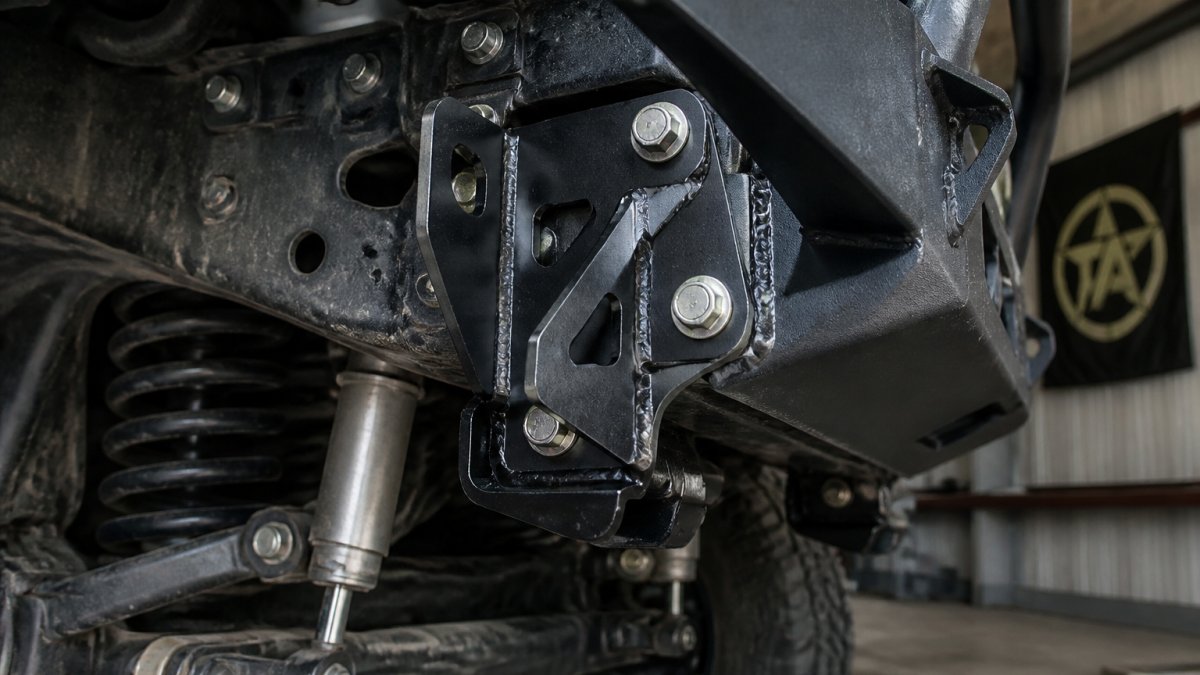
Your truck's suspension is engineered for specific weight distribution.
Lifted trucks with upgraded suspension handle bumper weight better than stock trucks.
Quality bumpers use multiple mounting points that spread weight across frame rails. Poor designs concentrate weight at few points, causing frame flex or stress cracks.
Impact Protection and Recovery Point Integrity
Recovery points must handle winch pull stress.
The best recovery points are welded solid to the bumper structure. Bolted recovery points can fail if bolts loosen or threads strip.
Crumple zone compatibility matters. Modern trucks have designed crumple zones that absorb impact energy.
Quality bumpers either integrate with the factory crumple zone or are designed to fail predictably before damaging the frame.
How to Install an Aftermarket Truck Bumper
Installation difficulty varies by bumper design and your mechanical skill level. Some bumpers bolt straight on. Others require welding or frame modifications.
Pre-Installation Checks and Tools
Before you start, verify your bumper fits your specific truck year, make, model, and bed length. Bumper mounting points vary between generations. A 2019 F-150 and 2021 F-150 might use different mounting brackets even though they look similar.
Gather these tools:
- Socket set (metric and standard)
- Torque wrench (most bumper bolts need 80-120 ft-lbs)
- Jack and jack stands (you'll need to access the frame)
- Wire brush or wire wheel (to clean mounting surfaces)
- Ratchet straps or come-along (to hold bumper in place during installation)
Check your truck's frame for rust or damage where the bumper mounts. Rust at mounting points can prevent proper bolt seating and cause vibration or loosening over time.
ADD Offroad Stealth Fighter Bumpers - S0127 →
Step-by-Step Installation Process
-
Disconnect the factory bumper, Most trucks have 4-6 bolts holding the factory bumper. Remove these and set the factory bumper aside. Some trucks also have wiring for parking sensors or fog lights that need disconnecting.
-
Remove factory brackets if necessary, Some aftermarket bumpers reuse factory brackets. Others require removing them completely. Check your bumper's instructions to see what stays and what goes.
-
Install new mounting brackets, Position the new bumper brackets on the frame and hand-tighten bolts. Don't fully tighten yet, you need to align the bumper first.
-
Install the bumper, With a helper, lift the bumper into position. Use ratchet straps to hold it centered while you bolt it to the brackets. Start bolts by hand to avoid cross-threading.
-
Torque all bolts, Once the bumper is positioned correctly, torque all bolts to the manufacturer's specification (usually 80-120 ft-lbs for frame bolts). Tighten in a cross pattern, not in sequence, to distribute pressure evenly.
-
Check alignment, Step back and verify the bumper is centered and sits at the correct height. Gaps between the bumper and fender should be even on both sides.
-
Reconnect wiring, If your bumper has integrated lights or your truck has parking sensors, reconnect wiring and test all functions.
-
Final inspection, Drive slowly around a parking lot and listen for rattles. Tighten any bolts that have loosened during the test drive.
Most bolt-on bumper installations take 2-4 hours for someone with basic mechanical skills. If your bumper requires welding or frame modifications, plan on professional installation or significant extra time.
Truck Army Tech Tip: Durability Testing You Can Do Yourself
You don't need a lab to test bumper durability. Here's what to check on your installed bumper:
Visual inspection every 500 miles: Look for cracks in welds, especially around corners and mounting points. Cracks start small and spread under repeated impacts. Catch them early.
Impact test on the trail: Your bumper will hit things.
Coating inspection: Look for areas where the powder coat is chipped or cracked, exposing bare steel. Small chips are normal.
Recovery point stress test: If you have a winch, occasionally use it to pull something heavy (a trailer, another truck).
These simple checks catch problems before they become expensive frame damage.
Choosing a Durable Bumper: What to Look For
When evaluating off-road bumpers, prioritize these factors:
Material and weight, Steel bumpers handle impacts better but weigh more. Aluminum is lighter but less durable under extreme impact. Match the material to your suspension capacity and intended use.
Welding quality, Examine welds on the product photos or in person if possible. Consistent, full-length welds indicate quality fabrication.
Mounting system, Bumpers that mount at multiple points across the frame distribute loads better than those with only two mounting points.
Powder coating, Multi-stage coating lasts longer than single-stage. Textured finishes hide scratches better than gloss.
Compatibility, Verify the bumper fits your specific truck year, make, model, and bed length.
Warranty, Quality bumper manufacturers back their products with warranties.
The ADD Offroad Stealth Fighter Bumpers available through Truck Army exemplify these durability principles. Built from high-quality steel with hammer black powder coating, they feature multiple mounting points for frame reinforcement and integrated recovery capability. The Stealth Fighter design distributes impact loads across the bumper structure rather than concentrating them at weak points. For Ford owners planning serious off-road use, these bumpers deliver the structural integrity and corrosion resistance that separates durable bumpers from ones that fail.

| Feature | What to Look For | Why It Matters |
|---|---|---|
| Material | Steel (50K-80K PSI tensile strength) | Better impact resistance and vibration fatigue resistance |
| Welds | Full-penetration, consistent beads | Prevents cracking under dynamic loads |
| Mounting | Multiple frame contact points with brackets | Distributes impact force instead of concentrating it |
| Coating | Multi-stage powder coat with primer | Protects steel from corrosion for 5-10 years |
| Recovery Points | Welded solid to bumper structure | Handles winch pulls without stripping or bending |
| Fit | Vehicle-specific design | Maintains frame geometry and safety features |
Frequently Asked Questions
What materials provide the best durability for off-road bumpers?
Steel and aluminum are the primary materials. Steel offers superior impact resistance and structural integrity, making it ideal for hardcore off-roading where collision risk is high. Aluminum is lighter and resists corrosion naturally, but has lower tensile strength. For maximum durability in extreme conditions, steel with quality powder coating provides the best long-term protection against both impacts and rust.
How does steel thickness affect off-road bumper performance?
Thicker steel increases structural integrity and impact resistance, but also adds weight that stresses your suspension. Most quality off-road bumpers use 3/16-inch to 1/4-inch steel plate as a balance between strength and weight. Thicker material resists deformation better under dynamic loads and shear stress, but verify your suspension can handle the additional weight before upgrading.
What should I look for in a winch-compatible bumper?
A winch-compatible bumper needs reinforced mounting points rated for the pull capacity of your winch. Check that the bumper has properly welded shackle mounts and recovery points with adequate frame reinforcement. The bumper should have a clear center section for winch installation and be designed to handle both forward pulls and side loads without twisting or deformation.
Does an off-road bumper affect my truck's approach angle?
Yes, bumper design significantly affects approach angle. A low-profile bumper preserves approach angle better than a tall, aggressive design. If you frequently tackle steep terrain or obstacles, measure the bumper's overall height and overhang before purchasing. Some aftermarket bumpers are specifically engineered to minimize impact on approach angle while maintaining protection.
Off-road bumper durability separates trucks that can handle rough terrain from those that rack up expensive frame damage. Steel construction, quality welding, proper mounting, and protective coating are non-negotiable. When you're ready to upgrade, Truck Army's selection of durable off-road bumpers gives you the protection and reliability that serious truck owners depend on.