

Table of Contents
- Why Tonneau Cover Bed Fitment Matters
- How to Measure a Truck Bed for a Tonneau Cover
- Truck Bed Length by Make and Model
- Checking Vehicle Configuration and Trim
- Tonneau Cover with Bed Rails Compatibility
- Truck Bed Liner and Tonneau Cover Compatibility
- Verifying Fit After Installation
- Truck Army Tech Tip
- Frequently Asked Questions
Last Updated: October 9, 2026
Why Tonneau Cover Bed Fitment Matters
Getting the right tonneau cover starts with verifying it fits your specific bed. A tonneau cover bed fitment mistake means wasted money, a poor seal, and potential damage to your bed or the cover.

Most fitment problems happen because people guess at measurements or assume all trucks of the same year and model have identical beds. They don't.
This guide walks you through verifying tonneau cover bed fitment before you buy: measuring your bed correctly, accounting for variations in your vehicle, and checking compatibility with existing bed accessories.
How to Measure a Truck Bed for a Tonneau Cover
Proper tonneau cover bed fitment depends on accurate measurement the first time. Use a steel tape, not cloth, cloth stretches. A 25-foot tape spans your entire bed. Measure twice.
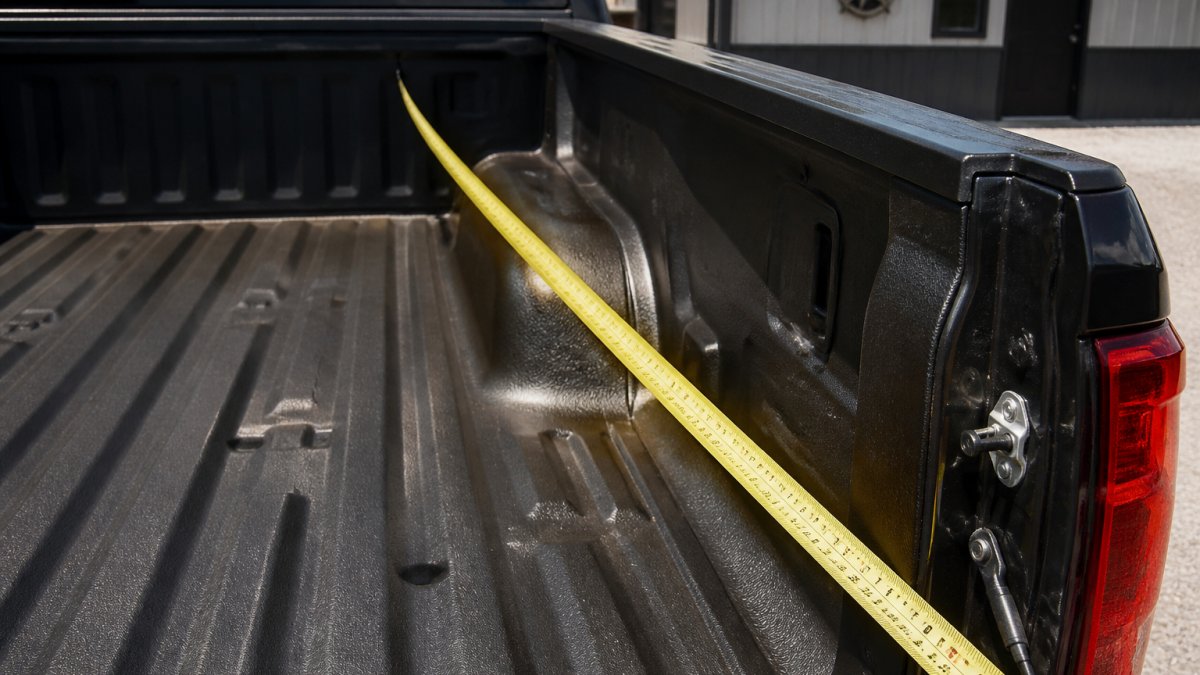
Measuring Inside Bed Rail to Bed Rail
Most tonneau covers fit between the inside edges of your bed rails, so you need the interior width measurement. Measure from the inside of one bed rail to the inside of the opposite rail at three points: front, middle, and near the tailgate. Record all three.

Standard truck bed widths are 54 inches for a short bed and 60 inches for a standard or long bed. If your measurements differ significantly from these standards, note it before selecting a cover.
Measuring Bulkhead to Tailgate
This is your bed length measurement, critical for tonneau cover bed fitment. Measure from the inside face of the bulkhead to the inside face of the closed tailgate, along the center of the bed, not along the sides where rails might affect the tape. This is the advertised bed length on most cover product pages.
Common bed lengths are:
- Short bed: 5.5 feet (66 inches)
- Standard bed: 6.5 feet (78 inches)
- Long bed: 8 feet (96 inches)
Your measurement should match one of these categories closely. If it falls between sizes, you'll need to determine which cover category fits best.
Accounting for Tailgate Clearance
Tonneau covers need clearance from the tailgate when closed. Some sit tight against it; others need a small gap, which affects usable bed space and sealing.
Check your cover's specs for tailgate clearance, most modern covers need 2 to 4 inches. Measure from the inside of your tailgate to where the cover will rest. If you have a tonneau cover bed fitment issue with seal contact, this is often the culprit. Tailgates vary by model, so know your type before finalizing your choice.
Truck Bed Length by Make and Model
Truck bed lengths are standardized into categories, but the number on a cover's product page is almost never what your tape shows. Understanding that gap prevents wrong orders.
A truck sold with a "5.5-foot bed" often tapes closer to 67 inches, not 66.
| Nominal bed | Typical advertised length | What a tape often shows |
|---|---|---|
| Short | 5.5 ft | ~66-67 in |
| Short (some half-tons) | 5.7-5.8 ft | ~68-70 in |
| Standard | 6.5 ft | ~78-79 in |
| Long | 8 ft | ~96-98 in |
Those ranges are typical, not universal. Exact figures vary by year, make, model, cab configuration, and trim, treat the table as a starting point and your measurement as the authority.
Bed length also varies within a single nameplate. A crew-cab half-ton usually gets the short bed, while a regular- or extended-cab version of the same truck can be ordered with the long bed.
How this plays out across common full-size trucks:
- Half-ton trucks from the major manufacturers generally offer a short bed in the 5.5- to 5.8-foot range, a standard bed around 6.5 feet, and a long bed around 8 feet. Availability depends on cab style and trim.
- Some configurations pair a specific bed with a specific cab only. You may not be able to get a long bed with a crew cab on a given model year, which locks cover options to one bed length.
- Mid-size trucks use their own bed categories, often around 5 feet and 6 feet, and those do not interchange with full-size cover fitments even when the tape numbers look close.
If your measurement lands between two categories, don't force it into the closer one. Check the cover's spec sheet for its exact length range. A cover built for a 5.5-foot bed may list a fitment window like 66 to 68 inches, if your bed tapes at 69, it's the wrong cover even though the category name sounds right. When in doubt, confirm the fitment range with the manufacturer or a fitment finder before ordering.
Checking Vehicle Configuration and Trim
Your truck's trim and configuration affect tonneau cover bed fitment. Different trims sometimes have different bed heights, rail designs, or tie-down points.

Check your truck's documentation or window sticker. Note bed length, trim level, and any factory options affecting fitment, some trucks come with bed liners or protective coatings that add thickness to the bed walls.
Crew cab trucks have shorter beds than regular-cab versions of the same model year. A 2024 Ford F-150 SuperCrew might have a 5.5-foot bed, while a regular-cab F-150 offers an 8-foot option, completely different tonneau cover bed fitment requirements. Confirm your cab style and bed length combination before shopping.
Tonneau Cover with Bed Rails Compatibility
Many trucks come with factory bed rails or side rails. Tonneau covers must work with them, and some covers are specifically designed for rail-equipped beds.
Truxedo Lo-pro Tonneau Cover - 581101 →
Measure your bed rail height. Some covers mount directly to the rails; others need rail adapters. Check whether your tonneau cover bed fitment works with your specific rail type and height.
Aftermarket bed rails vary even more. If you've added custom rails, measure their exact dimensions and verify cover compatibility before purchasing.
Some covers mount under the rails, affecting bed height and usable space; others mount over. Know which style you need before ordering.
Truck Bed Liner and Tonneau Cover Compatibility
Bed liners add thickness to your truck bed. A spray-in liner can add 1/4 to 1/2 inch to the bed walls; drop-in liners are thicker and can significantly affect tonneau cover bed fitment.
If you have a bed liner, measure interior bed dimensions with it installed, your tonneau cover bed fitment must account for the liner's thickness. Roll-up and soft covers typically accommodate liners well; hard covers may have fitment issues if the liner changes the bed profile. Talk to the cover manufacturer about your specific liner type to confirm fitment.
Verifying Fit After Installation
Measurement gets you to the right part number; installation confirms the cover actually fits.
Start with rail alignment. The rails should sit parallel and level along the bed. Lay a straightedge or taut string across them at the front, middle, and rear.
Next, check clamp placement. Clamps need solid, flat rail sections, not bed-rail caps, plastic trim, or a taper.
Then verify tailgate clearance. Close the tailgate slowly and watch where it meets the rear seal or rail. It should close without lifting, pinching, or rubbing.
Finally, check seal contact. Run a hand along the full perimeter where the cover meets the rails and bulkhead.
Cover-type-specific clearance notes
Different cover designs have different clearance and mounting requirements, so the check above isn't one-size-fits-all:
- Soft roll-up covers need the rear rail positioned so the tailgate can close against it without pinching the fabric. They typically tolerate more bed-rail variation than hard covers because the fabric flexes.
- Folding covers need clearance for the panels to stack and fold forward. If a bed liner or bed extender sits in the fold zone, the panels will not lay flat. Check that the folded stack clears any accessories near the bulkhead.
- Retractable covers run on internal tracks and need the canister at the bulkhead to clear the cab-side bed wall and any factory tie-downs. They are the least forgiving of an out-of-square bed, so rail alignment matters most here.
- Hard one-piece covers sit rigid, so any bed-rail height variation shows up as a gap or a high corner. They also leave the least room for a thick drop-in liner.
Troubleshooting gaps, pinched seals, and leaks
If something is off after installation, work through this sequence before assuming the cover is wrong:
- Re-check rail alignment. Splayed rails cause gaps that look like seal failures. Straighten the rails first.
- Re-check clamp torque and placement. A loose or mis-seated clamp lets the rail drift, which opens a gap at the opposite end.
- Check for pinched seals. A seal folded under itself at a corner will not seal. Lift the edge, straighten the seal, and reseat it.
- Check tailgate contact. If the tailgate pushes the rear seal up, water runs under it. Adjust the cover forward.
- Check for accessory interference. A bed liner lip, bed extender, or factory tie-down can hold a rail up off the bed. Trim or relocate the accessory if it is the cause.
- Water-test the perimeter. With the cover closed, run a hose along the top and watch the inside edges for drips. Trace any drip back to the nearest gap.
If you've worked through all six steps and the cover still won't seal or sit flat, it's likely a genuine fitment mismatch, not an adjustment problem. Contact the manufacturer with your measurements and photos. Many covers have a defined adjustment range, if your bed falls outside it, a different model or size is the fix.
Take photos of the installed cover from the front, rear, and both sides, plus a close-up of each corner seal. These document the fit and speed up any warranty or return conversation if a problem turns out to be a defect rather than an installation issue.
Truck Army Tech Tip
Before you measure, clean out your truck bed completely. Dirt, gravel, and debris throw off measurements and hide where the cover will actually sit. A clean bed also lets you spot existing damage or rust that might affect how a new cover sits.
Verifying tonneau cover bed fitment correctly saves you time, money, and frustration. Accurate measurements, understanding your truck's specific configuration, and checking compatibility with existing bed accessories are the keys to getting a cover that works. At Truck Army, we carry tonneau covers from trusted brands like TruXedo and ReTrax, each designed with specific fitment requirements in mind.
Frequently Asked Questions
How do I find out what size bed my truck has?
Check your truck's owner's manual or door jamb sticker for the advertised bed length (typically 5.5, 6.5, or 8 feet). However, actual interior measurements often differ from advertised lengths. Measure from the inside of the bulkhead to the inside of the tailgate to get your true bed length. This measurement is essential for tonneau cover bed fitment, as covers are sized to actual interior dimensions, not advertised lengths.
Does tonneau cover fitment depend on the truck's year, make, and model?
Yes, absolutely. Tonneau cover fitment depends on year, make, model, trim, bed length, and bed configuration. Even within the same model year, different trims or cab styles may have different bed lengths or mounting rail locations. Some covers won't fit trucks with bed caps, bed liners, or aftermarket bed rails. Always verify your specific vehicle configuration before purchasing, as fitment varies significantly across manufacturers and model generations.
Can a tonneau cover fit if my truck has a bed liner or bed rails?
It depends on the cover type and your specific bed liner or rails. Some tonneau covers are compatible with bed liners, while others require a bare bed. Bed rails can interfere with cover mounting or sealing. Check the cover's compatibility specifications for your exact bed liner brand and rail configuration. If you have existing bed protection or rails, confirm compatibility before ordering to avoid fitment issues.
What should I do if my truck bed measurements do not match the listed cover dimensions?
First, verify your measurements are accurate by measuring multiple times and checking against your truck's specifications. If measurements still don't align with cover dimensions, contact the manufacturer or retailer with your exact vehicle year, make, model, trim, and bed length. Some covers accommodate slight variations, while others require exact matches. Don't assume a close fit will work, poor fitment can lead to leaks, wind noise, and cover movement.