

Table of Contents
- Start With Your Hauling Needs and Payload Limits
- Truck Bed Accessories for Hauling: Protection and Organization
- Tonneau Cover for Hauling: Security and Efficiency
- Truck Toolbox Buying Guide: Storage That Works
- Loading, Unloading, and Bed Access
- Verify Compatibility Before You Buy
- Truck Army Tech Tip: Prioritize and Budget Smart
- Frequently Asked Questions
Last Updated: October 10, 2026
Start With Your Hauling Needs and Payload Limits
Choosing truck accessories for daily hauling starts with one critical question: what's your truck actually rated to carry? Too many truck owners buy accessories without checking their vehicle's payload capacity first. This oversight leads to overloaded trucks, damaged suspension, and unsafe handling. Before you add storage, toolboxes, or bed liners, you need to know your truck's limits.
Your payload capacity is the maximum weight your truck can safely carry in the bed, including passengers, cargo, and accessories. Exceed it, and you compromise safety and potentially void your warranty.
Know Your Truck's Payload Capacity
Your truck's payload capacity is listed in the owner's manual and on a sticker inside the driver's door jamb. It varies by model year, configuration, trim level, engine choice, suspension package, and bed length.
Write down your exact payload number before shopping. Subtract accessory weights from this number to find your actual hauling capacity for cargo.
Match Accessories to Your Load Type
Different loads need different accessories. Daily hauling isn't one-size-fits-all.
Heavy, compact loads (building materials, mulch, gravel) need:
- Bed liner for protection against impact and abrasion
- Tie-downs to secure the load
- Side steps for safe bed access
Fragile or weather-sensitive cargo (tools, equipment, materials) need:
- Tonneau cover for weather protection and security
- Cargo organization to prevent shifting
- Toolbox for smaller items
Long materials (ladders, lumber, pipes) need:
- Ladder rack to keep items secure and off the bed floor
- Headache rack for safety
Mixed daily loads (tools, supplies, occasional cargo) need:

- Toolbox for organized storage
- Tonneau cover for security
- Bed organization system
Be honest about what you actually haul. If you're moving mulch once a year and carrying hand tools most days, don't over-invest in heavy-duty hauling gear. Match your setup to your real needs.
Truck Bed Accessories for Hauling: Protection and Organization
Your truck bed is the foundation for everything else. Protecting it and organizing it properly makes daily hauling safer, faster, and more efficient.
Bed Liners and Weather Protection
A bed liner protects your truck bed from scratches, dents, and corrosion, preventing rust and damage that reduce resale value.
Spray-in liners bond to the bed for seamless protection; drop-in liners sit loosely and are easier to remove. Choose spray-in for permanent protection, drop-in for flexibility.
Pair a bed liner with a tonneau cover or organization system to protect your bed and keep cargo secure.

Cargo Organization and Tie-Downs
Loose cargo shifts during acceleration, braking, and turns, damaging your bed or falling onto the road. Proper tie-downs and organization prevent this.
Tie-down points should be rated for the weight you're securing. Check your owner's manual for factory tie-down loop capacity. For heavy loads, consider adding bed rails with additional anchor points.
Cargo organization systems, bed dividers, cargo nets, and storage boxes keep smaller items contained and accessible throughout the day.
Tonneau Cover for Hauling: Security and Efficiency
A tonneau cover provides security, weather protection, and improved fuel efficiency by reducing wind drag, meaningful benefits for regular highway hauling.
For daily hauling, the right tonneau cover depends on how often you need bed access and what you're protecting.
Tonneau Cover Types and Trade-Offs
Roll-up covers are affordable and easiest to use daily, rolling toward the cab for full bed access in seconds. Trade-off: less security than hard covers and weaker weather sealing. Ideal if you access your bed multiple times daily.
Hinged hard covers provide maximum security, durability, and weathertightness. Trade-off: heavier, more expensive, and require full opening for bed access. Best if you haul the same load all day without frequent access.
Folding covers fold in sections for partial bed access without opening fully. More secure than roll-ups, more convenient than hard covers, but more complex and expensive than roll-ups. Good for mixed daily hauling.
Material matters: vinyl is affordable; aluminum is durable and low-maintenance but heavier and pricier; fiberglass offers middle ground.
Matching Cover Type to Your Hauling Pattern
For all-day loads, use a hard or folding cover. For frequent loading/unloading, use a roll-up. For unattended trucks, prioritize security with a hard cover.
Verify compatibility with toolboxes or bed organization systems. Some hard covers don't sit flush over bed-mounted toolboxes, creating weather gaps. Roll-ups are more forgiving with obstacles.
Hard covers seal tightly and keep rain out; roll-ups have gaps where water seeps in during heavy rain.
Roll-ups install quickly and remove in minutes for tall loads; hard covers require more involved installation. Choose roll-up if you might swap covers seasonally.
Truck Toolbox Buying Guide: Storage That Works
If you carry tools, supplies, or small equipment daily, a toolbox keeps everything organized and accessible. It beats throwing everything loose in the bed, where items get lost, damaged, or shift during driving.

Toolbox Types and Placement
Toolboxes mount in different locations, each with trade-offs:
Bed-mounted toolboxes sit in your truck bed, taking up cargo space but keeping tools organized and visible. Good if you're not hauling large loads.
Side-rail toolboxes mount along the bed rails. They free up bed space for cargo while keeping tools accessible. The WESTIN Truck Bed Side Rail Tool Box is designed for this purpose, fitting snugly along the rails without eating into your hauling capacity.
Under-bed toolboxes mount underneath the frame, staying out of the way but harder to access. Use for tools you don't need daily.
Chest toolboxes are portable and mount anywhere. They're flexible but take up bed space. The DEE ZEE TOOL BOX is lightweight and portable, ideal if you move between vehicles or need flexibility.
Ladder Rack Pro 66" Pro Serie - F2020022 →
Size, Weight, and Access
Toolbox weight directly reduces your payload capacity. An 80-pound toolbox leaves 80 fewer pounds for cargo.
Subtract toolbox weight from payload capacity to find your actual cargo capacity. A 1,500-pound payload minus an 80-pound toolbox leaves 1,420 pounds for cargo.
High-mounted toolboxes are easy to reach but reduce clearance; low-mounted ones require bending. Side-rail toolboxes split the difference.
Size your toolbox for what you actually carry. Oversized toolboxes waste space and weight; undersized ones force you to leave tools behind.
Loading, Unloading, and Bed Access
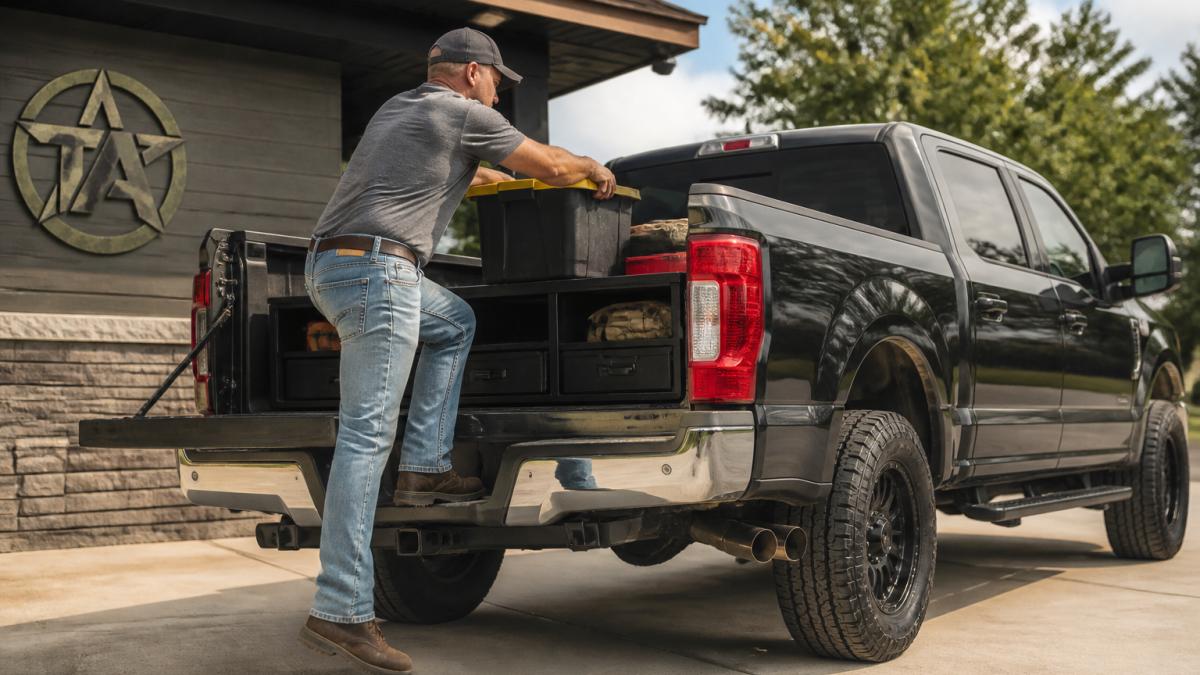
Truck beds sit 30 to 36 inches off the ground. Climbing in and out repeatedly strains your back, knees, and ankles. Safe, efficient bed access is a practical necessity for daily hauling.
Side Steps vs. Running Boards: What's the Difference?
Side steps bolt to the frame behind the front wheels, typically 6 to 8 inches wide. They're affordable, easy to install, and don't interfere with tonneau covers. Trade-off: they only help at one location, so you're still reaching across the bed width.
Running boards run the full length of the truck bed, providing continuous step surface along the entire side. They let you step up anywhere along the bed. Trade-off: more expensive, add weight, and can interfere with some tonneau covers or bed-mounted accessories.
Choosing the Right Access Solution
Use a side step if you access the bed from one location. Use a running board if you work across the entire bed width, as it reduces strain and gives more flexibility.
Check your owner's manual for factory running boards or integrated steps.
Taller trucks (lifted or on larger tires) need steps that account for extra height.
Bed Extenders for Long Materials
Bed extenders mount on the tailgate and extend the bed, useful for hauling long materials. They reduce overhang and improve stability.
Access and Tonneau Cover Compatibility
Verify side steps or running boards work with your tonneau cover. Check the installation guide.
Bed-mounted toolboxes can block bed access, especially with fixed-location side steps.
Verify Compatibility Before You Buy
Many truck owners order accessories only to discover they don't fit. Bed length, configuration, mounting points, and clearance all matter.
Bed Length and Configuration Matter
Truck beds come in three standard lengths: 5.5, 6.5, and 8 feet. A tonneau cover for a 5.5-foot bed won't fit a 6.5-foot bed. Toolboxes designed for one length may not mount on another.
Crew cabs have shorter beds than regular cabs with the same bed length. Accessories designed for one cab style may not work with another.
Before buying, confirm your truck's exact bed length and cab style. Check your registration, owner's manual, or window sticker. Then verify the accessory is rated for your specific configuration.
Check Mounting Points and Clearance
Accessories mount to specific points on your truck. Bed liners need proper anchoring. Toolboxes need stable mounting surfaces. Tonneau covers need secure attachment to the bed rails.
Some trucks have factory tie-down points. Others don't. Some have bed rails. Others have smooth beds. These differences affect which accessories work and how they install.
Clearance matters too. A tall toolbox might interfere with a tonneau cover. A ladder rack might hit a cab roof rack. A side step might catch on a curb or driveway.
Before ordering, check the accessory's installation guide. Confirm it lists your truck's year, make, model, and bed length. If it doesn't, contact the manufacturer or retailer to verify compatibility.
Truck Army Tech Tip: Prioritize and Budget Smart
You don't need every accessory at once. Prioritize based on your actual hauling needs and your budget.
Essential for daily hauling:
- Bed liner (protects your truck's most valuable part)
- Tonneau cover (security and weather protection)
- Tie-downs (cargo safety)
High-value additions:
- Toolbox (if you carry tools or supplies daily)
- Side steps (if you access the bed frequently)
- Cargo organization (keeps small items contained)
Nice-to-have accessories:
- Ladder rack (only if you haul long materials)
- Bed extender (only if you haul long items regularly)
- Lighting upgrades (useful but not essential)
Start with the essentials. Use them for a few months. Then add accessories based on what you actually need. This approach saves money and ensures you buy accessories that solve real problems, not theoretical ones.
Truck Army carries a curated selection of these essentials. The Ladder Rack Pro 66" Pro Series handles long materials safely. The tonneau covers and toolboxes are all designed for straightforward installation and real-world durability.
Choosing truck accessories for daily hauling comes down to three steps: know your payload limits, match accessories to your actual loads, and verify compatibility before buying. Too many truck owners skip one of these steps and end up with accessories that don't fit or don't solve their real problems. Take the time upfront.
Frequently Asked Questions
What truck accessories are most useful for daily hauling?
The essentials depend on what you haul. A tonneau cover protects cargo from weather and theft. A bed liner prevents cargo from shifting and damaging the bed. Tie-downs and cargo restraint systems keep loads secure. If you carry tools or small items, a toolbox keeps them organized. A ladder rack handles long materials safely. For frequent loading and unloading, running boards or side steps reduce strain and improve safety.
How do I check whether a truck accessory fits my truck before buying?
Verify your truck's year, make, model, trim level, and bed length, these details matter. Check the product listing for fitment compatibility with your exact configuration. Confirm bed length, since a 5.5-foot bed fits different accessories than a 6.5-foot or 8-foot bed. Look for mounting point specifications and clearance requirements. Contact the manufacturer if fitment details are unclear. Many retailers offer return policies if an accessory doesn't fit as expected.
How do truck accessories affect my payload and towing capacity?
Every accessory adds weight to your truck. A tonneau cover might add 50-100 pounds; a toolbox can add 50-150 pounds depending on size and material. Check your truck's payload rating in the owner's manual or on the door jamb. Subtract the weight of accessories and passengers from your payload capacity to see how much cargo you can safely carry. Towing capacity is separate from payload; consult your manufacturer's specs for both limits.
What should I check before buying a truck toolbox?
Determine where you want it: in the truck bed, under the bed, or on the side rails. Measure available space and confirm the toolbox dimensions fit without blocking bed access or cargo room. Check the weight capacity and material, aluminum is lighter, steel is more durable. Verify mounting hardware is included and compatible with your truck. Consider weatherproofing and locking mechanisms if you store valuable tools. Read reviews about durability and ease of access for your specific use case.